

The Challenge
A leading washing machine manufacturer was considering developing a new feature: a drum divider that allows users to separate multiple loads of laundry within a single wash cycle (i.e., to separate color clothes from white clothes). Before the company invested considerable resources into the development of this new feature, they sought to understand if the proposed feature was compelling to customers and whether or not it could help win them market share from their competitors. More specifically, they wanted to understand if the new product would add market share or if it would simply cannibalize their existing market-leading product. Additionally, the company needed guidance on how to price this new feature in the existing market. They needed to know if customers were willing to pay a premium for the feature, and if so, how much?
What We Did
Applied Marketing Science (AMS) surveyed 301 homeowners who had either recently purchased a washing machine or were considering purchasing a washing machine in the near future. AMS researchers then utilized conjoint analysis as the primary methodology to answer the client’s research objectives. Conjoint analysis is a survey technique and discrete-choice model used in market research to measure consumer preferences for products and services. Rather than directly asking customers how much they would pay, a conjoint survey presents them with a series of competing, attractive offers in a carefully designed experiment.
Respondents were shown three different washing machine options, each with varying levels of several known attributes that drive customer choice: brand, load type, machine capacity, wash cycle length, remote sensing technology, price, and the new feature of interest: the drum divider. Respondents select the washing machine option they most prefer and then indicate whether or not they would actually purchase the option they selected. Respondents complete this exercise eight times, and are presented new options each time.
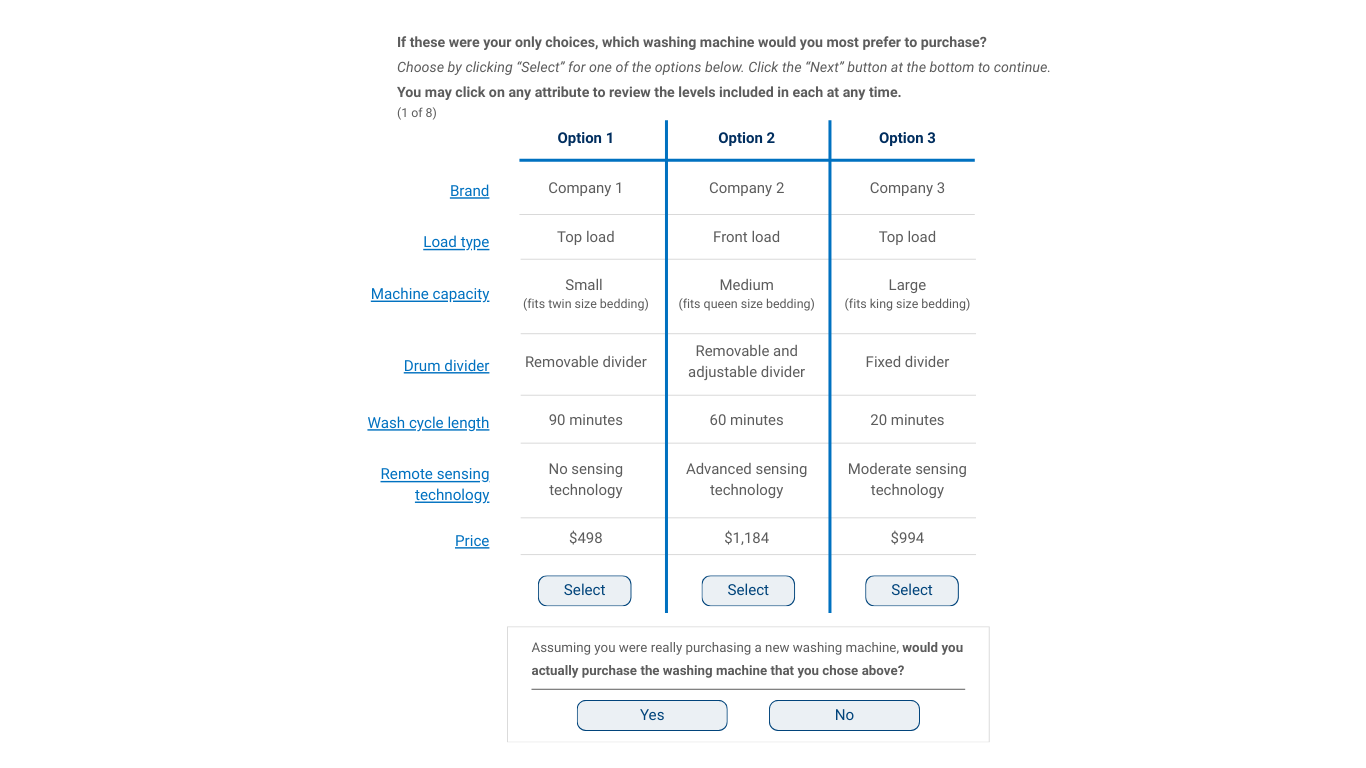
From this data, researchers create a model of customer choice which helps to measure:
- Which attributes most strongly drive customer choice.
- How customers value each level within an attribute (what levels are most and least preferred).
- Price elasticity for each level (how much customers are willing to pay for a better level).
The Outcome
Using conjoint analysis, AMS researchers were able to effectively address the client’s research objectives, including customer preference and purchasing decisions, and the impact this new feature would have on their market share. Our research showed that the client’s proposed feature—the drum divider—was, surprisingly, a weaker driver of customer choice than anticipated. Other attributes such as price and machine capacity were still the strongest drivers. However, the drum divider still makes up about 10% of customer choice and is comparable with several other attributes of a washing machine such as brand, wash cycle length, load type, and remote sensing technology.
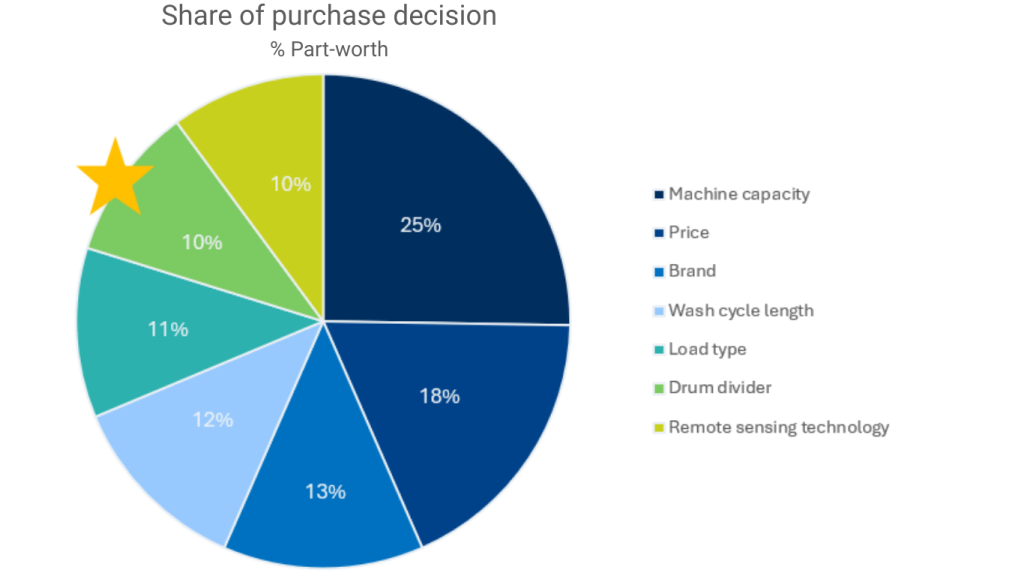
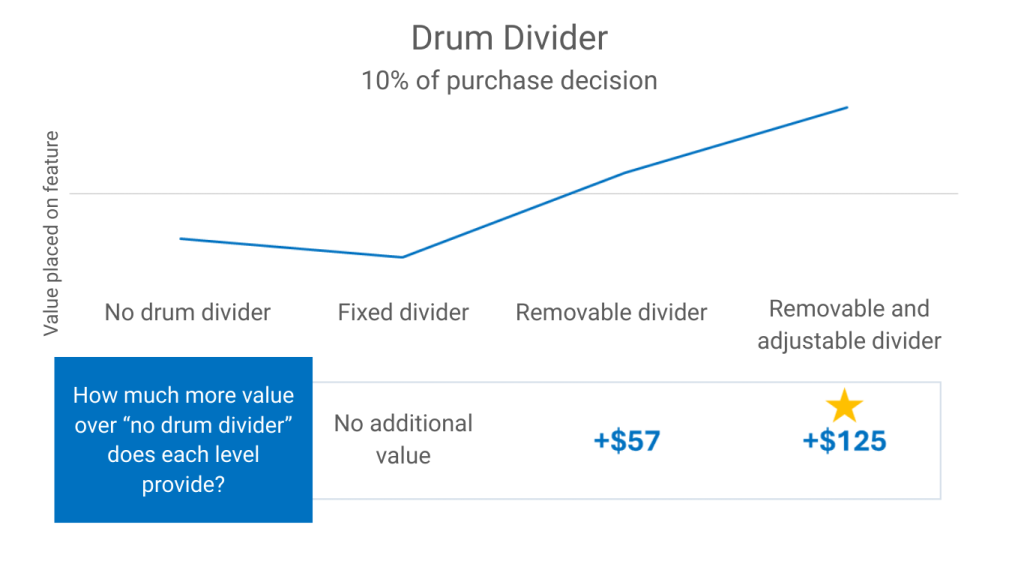
Researchers also found that a “fixed divider” (i.e., a divider that is fixed in the washing machine and cannot be removed or adjusted) provides no additional value in the decision-making process and customers are not willing to pay for this feature. However, customers are willing to pay more for a ‘removable divider’ (+$57) and even more for a ‘removable and adjustable divider’ (+$125).
Next, we simulated the client’s proposed product, a washing machine with a removable and adjustable divider, alongside the four primary competitive products in the category to simulate how the new feature would impact market share. We also included the client’s existing market leading product in the simulation. We simulated the new product entering the market at varying prices, to understand how market share fluctuated at each price.
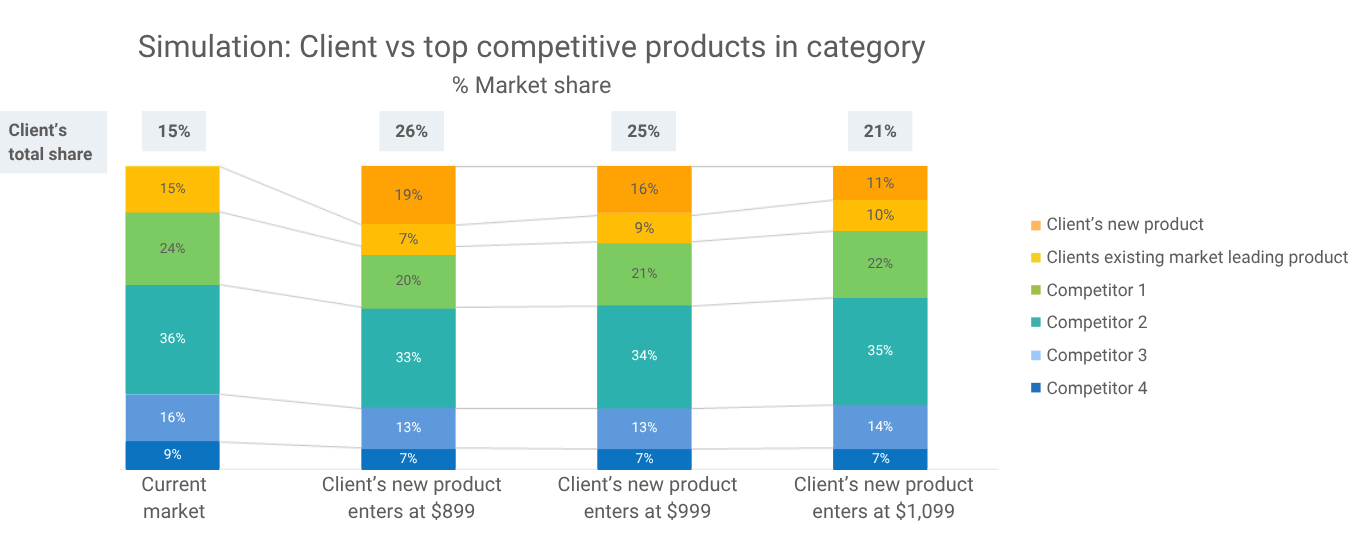
- Bar 1: Before the client’s new product enters the market, the client already has 15% market share.
- Bar 2: When the new product enters the market at $899, the new product garners 19% market share. However, 8% of that share is cannibalized from the client’s existing market leading product. Still, the client gains 11% new market share.
- Bar 3: When it enters at $999, it gains 16% market share, 6% of which is cannibalized. Still, the client gains 10% new market share.
- Bar 4: And when it enters at $1,099, it gains 11% market share, 5% of which is cannibalized. The client gains 6% new market share.
The bottom line
While the drum divider may not be a major factor in customer preference, it can still influence purchasing decisions. To make an impact, the client must offer a ‘removable and adjustable’ divider since customers aren’t willing to pay for a basic version of this feature. We recommend setting the entry price at $999, as it is the optimal price point for maximizing both market share and product profitability. These insights were valuable for our client’s business decision-making, allowing them to enter the market with an informed, data-driven pricing strategy centered around customer perception of value.
 Download the PDF